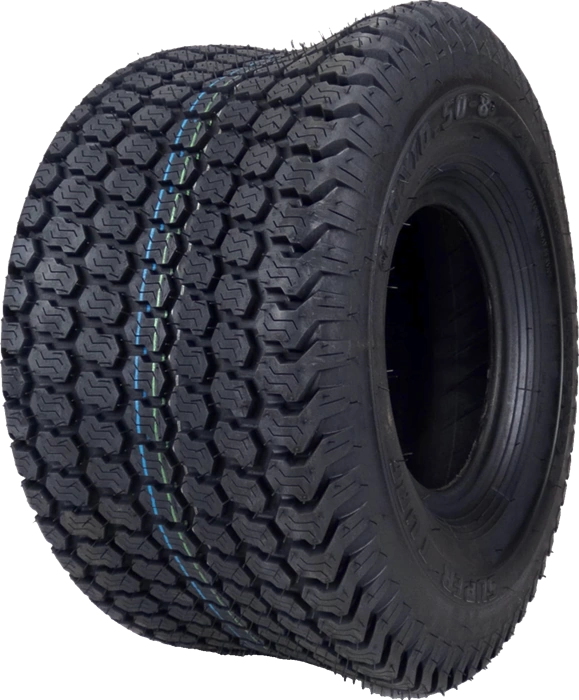

The short answer: on a hill yard, neither name on the sidewall decides how long the tire lasts — ply rating and driving habits do. A 6-ply K500 will outlast a 4-ply Turf Master on slopes, and a 4-ply K500 won’t. Match the ply to the yard and either tread mows fine; we stock the Kenda because it delivers that carcass at a better price.
This is one of the questions I actually get on the phone: “My yard’s on a hill and I keep chewing through rear tires — is a Kenda K500 or a Carlisle Turf Master going to last me longer?” Both are turf tires, both have been on lawn tractors for decades. Here’s how I think about it after 22 years of selling both.
They’re doing the same job
The Kenda K500 Super Turf and the Carlisle Turf Master are both classic turf treads: shallow, wide-shouldered blocks designed to grip grass without tearing the lawn. Neither is an aggressive lug tire. If you set them side by side, the tread patterns look like cousins — because they’re solving the same problem, which is traction on turf without leaving marks. The Turf Master has been factory-original equipment on a huge number of machines, so a lot of people are “replacing like with like” when they buy one. The K500 is the tire we stock and reach for, and it’s the direct equivalent.
On a hill, tread pattern isn’t what wears out
Here’s the part people don’t expect. On a flat residential lawn, a turf tire dies of old age — the tread slowly rounds off over many seasons. On a hill yard, it dies a different death: the sidewall goes first. When you mow across a slope, the tire is constantly scrubbing sideways and flexing the sidewall, and the machine’s weight shifts onto the downhill tire. That side-loading is what cracks shoulders, pinches tubes, and rolls a soft tire off the rim.
Head to head, at equal ply
If you put a K500 and a Turf Master next to each other in the same ply rating, here’s the honest comparison from what crosses our floor:
| What I see | |
|---|---|
| Tread life | Very close. At equal ply, the K500 compound wears a touch harder in my experience — a bit more life on abrasive, sandy, or sloped ground. Not night-and-day. |
| Ply availability | This is where it matters. The K500 is easy to get in a true 6-ply. At retail the Turf Master is often only stocked in 4-ply, which is exactly the wrong tire for a hill. |
| Sidewall on slopes | Comparable at the same ply. The stiffness comes from the ply rating and construction, not the brand. |
| Price & supply | We buy Kenda direct — no importer stacking a markup — so the K500 is usually the better-priced tire on our shelf and I can get sizes fast. |
So: at equal ply they’re close, with a slight edge to the K500 on wear and a real edge on being able to actually buy it in 6-ply. That last point is why, for a hill yard, I steer people to the K500 — not because the Carlisle is a bad tire, but because the version of it you want (6-ply) is the hard one to find.
When to stop buying turf tires entirely
If your slope is steep enough that you’re sliding — not just wearing tires, but actually losing grip going up or across — a turf tread is the wrong tool no matter whose name is on it. That’s when I move people to an AG / R1 (chevron-lug) rear. You give up some lawn cosmetics (a lug tire leaves faint tracking on soft ground) and you gain real climb. For a genuinely hilly property that trade is usually worth it.
What I’d actually do
- Moderate slope, care about the lawn: Kenda K500 Super Turf in 6-ply. Same look as the Carlisle you’re replacing, easier to get in the ply you need.
- Flat residential lawn: either tire in 4-ply is fine — buy on price and availability.
- Steep hill, sliding: step off turf entirely and run an AG/R1 lug rear.
You can see the K500 and the other turf rears we stock, filtered to your size, on the mower tires page. Not sure which rear size you’re on? The how-to-read-a-tire-size guide walks through it, or read it straight off the sidewall and give us a call.
Common questions
Tires in this guide
Sold and shipped by Greater Cleveland Tire — from our Cleveland warehouse in one business day.
The one on our shelf