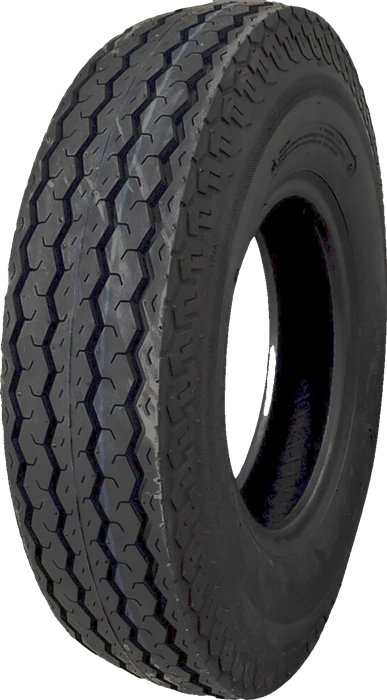

The short answer: 4.80-8 means the tire is about 4.8 inches wide and mounts on an 8-inch rim. That’s it — two numbers, width and rim. Notice what’s missing: the size doesn’t tell you how tall the tire stands, which is the one thing everybody actually wants to know.
If you’re replacing a dolly, cart, or small trailer tire and the sidewall says 4.80-8, you’re in the right place. Four minutes here and you’ll know exactly what to order — and you’ll dodge the 4.00-8 mix-up that generates half the returns in this size.
The two-number system, decoded
Small equipment uses two ways of writing a size. The three-number format (like 23x10.50-12) spells everything out: height, width, rim. The older two-number format — 4.80-8, 4.00-8, 5.30-12 — only gives you section width and rim diameter, both in inches. So 4.80-8 reads: a tire roughly 4.8″ wide across the tread, sized for a wheel that measures 8″ across at the bead seat.
The rim number is the one people get wrong. It’s the diameter of the wheel, not the width of anything, and it has to match exactly. A 4.80-8 will never stretch onto a 9-inch wheel, and it’ll never seat on a 7. If you want the whole sizing system in one place, our guide to reading tire sizes covers both formats.
So how tall is it? The number won’t tell you
Here’s the catch with two-number sizes: height is implied, not stated. Most 4.80-8 tires stand somewhere in the neighborhood of 15 to 16 inches tall, but that varies a little by brand, tread, and inflation — the sidewall number itself is silent on it. If overall height matters for your machine (jack clearance, fender gap, matching a tire on the other side), measure your old tire across its full diameter or pull the manufacturer’s spec sheet. Don’t guess it off the size.
There’s a back-door clue, though, and it comes from the tube shelf. Inner tubes are sold to cover a range of tires — one stocked tube is labeled 4.00/4.80-8 because it fits both sizes. That combo listing is the industry quietly telling you those two tires are close cousins in diameter: same rim, same neighborhood in height, different width. When two sizes share a tube, they’re nearly interchangeable in the space they occupy.
What actually runs a 4.80-8
This is one of the workhorse sizes of the small-wheel world. You’ll find 4.80-8 on hand trucks and moving dollies, garden and yard carts, wheelbarrow conversions, trailer jack wheels, and a whole lot of small utility trailers. It’s the “everything around the property” size — which is exactly why it fails at the worst time. These tires sit loaded in a shed for eleven months, then get asked to move a half ton of mulch on Memorial Day weekend.
If yours is on a trailer, ply matters more than tread: a trailer tire carries its load constantly, not just when you’re pushing it. Browse the trailer tires page and match the ply rating to what the axle actually hauls — Deestone is one of the trailer-tire brands we stock in this size class.
4.80-8 vs. 4.00-8: the classic mix-up
4.00-8
- Width
- about 4.0″
- Rim
- 8″
- The practical difference
- Narrower and a little shorter — common on tillers, hand trucks, some carts
4.80-8
- Width
- about 4.8″
- Rim
- 8″
- The practical difference
- Wider, slightly taller, more air volume — carries more load at the same pressure
Same rim, different tire. The two get confused constantly because worn sidewalls are hard to read and the wheels look identical from six feet away. The good news: the mix-up is usually survivable. Both mount on the same 8″ wheel, and if the fender clearance is there, a 4.80-8 is a common upsize from a 4.00-8 — more footprint, more load capacity. Going the other direction (4.00-8 where a 4.80-8 lived) gives up capacity, so check what the axle carries first. If your sidewall reads 4.00-8, the 4.00-8 size page has what we stock.
The tube question
Plenty of 4.80-8 tires run tubeless on a clean rim. But this size lives on old steel wheels, and old steel wheels rust where the bead seats — which is why a tube is the standard fix for the cart that’s mysteriously flat every spring. The stocked 4.00/4.80-8 combo tube covers both sizes above with a TR-13 valve stem, so you don’t need to agonize over which tire you have to buy the right tube. Our rule on these: “If the wheel’s older than the kid pushing the cart, put a tube in it.” Find them on the inner tubes page.
Common questions
Tires in this guide
Sold and shipped by Greater Cleveland Tire — from our Cleveland warehouse in one business day.
The exact size this guide explains